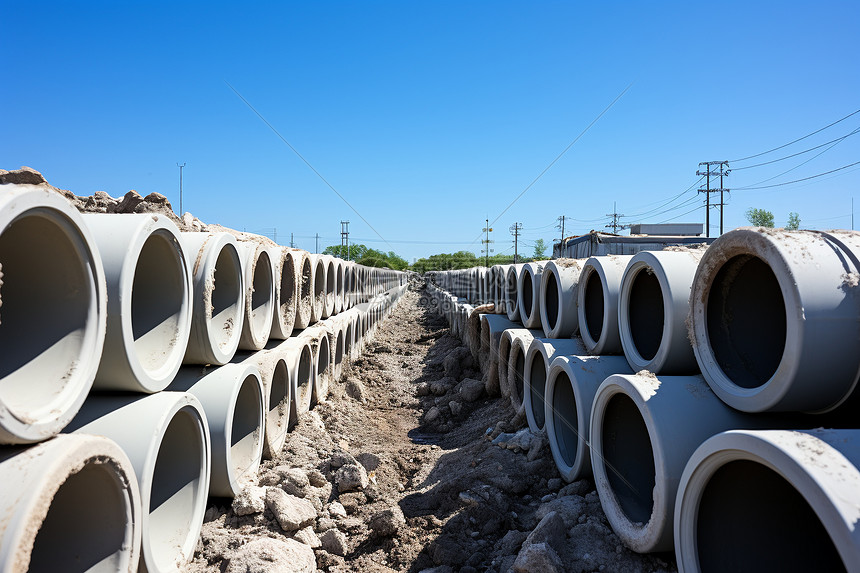
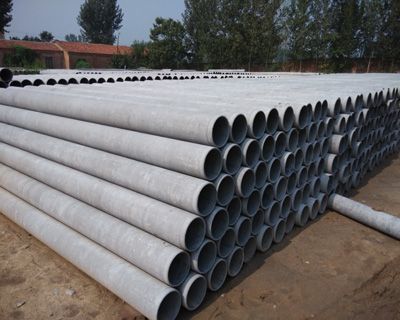
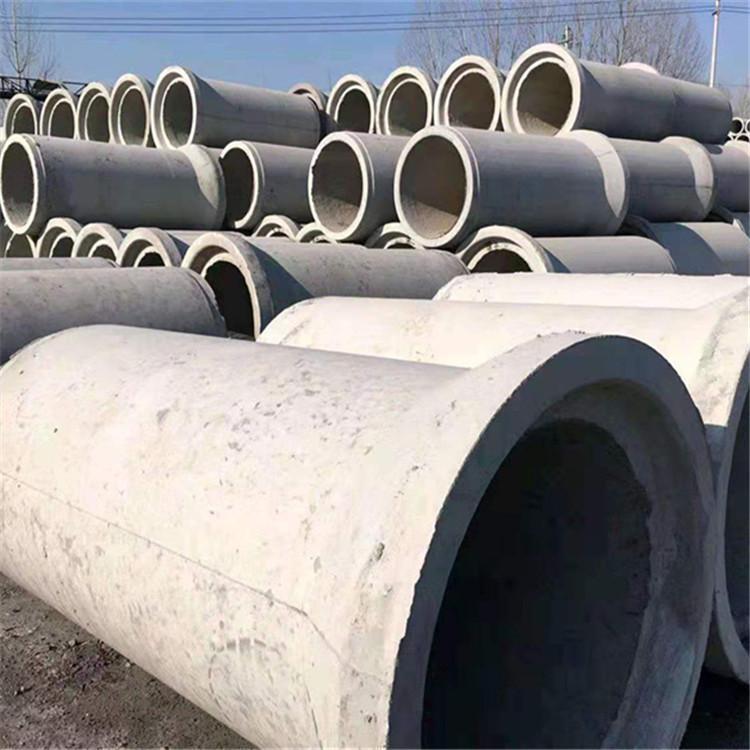
Reinforced concrete pipes are prefabricated pipes made from a combination of concrete and steel reinforcement. They possess high strength, excellent durability, and are cost-effective and practical. They are widely used in infrastructure projects such as urban drainage, water supply systems, integrated pipeline corridors, and road culverts.
Key advantages:
High strength, large load-bearing capacity: suitable for scenarios with deep burial depths and high load requirements.
Good durability: It is resistant to corrosion and seepage, and has a long lifespan (typically lasting over 50 years).
Good fire-resistant properties: non-combustible, capable of maintaining structural integrity.
Relatively cost-effective: abundant raw materials and low maintenance costs.
Performance
1. Core principle: complementarity
Concrete: High pressure resistance, but low tensile strength and high brittleness.
Reinforced steel: high tensile and pressure strength and good toughness.
Combined effect: The concrete undergoes pressure and the steel undergoes tensile force, and the two work together through bonding force to form a high-performance composite material.
2. Main advantages
Strong carrying power: Take full advantage of the mechanical advantages of both materials and have a high overall strength.
Good durability: Concrete wraps in reinforced steel, providing alkaline protection against corrosion.
Good fire resistance: concrete is a non-combustible material and provides insulation to protect the internal reinforcing.
Strong holisticness and moldability: it can be poured into a holistic structure of various shapes and has good stiffness.
Economical and practical: abundant raw materials and relatively low maintenance costs.
3. Main drawbacks
Significant: It affects structural span and increases transport and construction burden.
Poor crack resistance: The concrete is prone to cracking in the strained area (which needs to be controlled by design).
The construction is complex: there are many processes, long cycles, and high environmental and conservation impacts.
Remodeling difficulties: structural adjustment is difficult after forming.
Application
1. Municipal drainage system
Rainwater discharge: Rainwater trunk pipes and collection systems for urban roads and squares can withstand soil pressure and ground vehicle loads.
Sewerage transport: The corrosion resistance (particularly when special cement or lining is used) and resistance to leakage prevent the leakage of sewage to the environment for the transport of domestic and industrial wastewater.
2. Water Resources and Water Transmission Engineering
Water diversion: It is used in low-pressure water pipelines such as water diversion in reservoirs and water transfer across regions.
Farmland irrigation: serves as a dry water pipe for large irrigation areas.
3. Integrated pipelines and cable channels
Power cable casings protect high-voltage cables, provide mechanical protection and flame retardants.
Communication line channels: Provide collective laying space for fiber optics and communication lines.
Integrated pipe galleries: bulk structures that serve as prefabricated, assembled pipe galleries.
4. Transportation engineering
Road / railway culvert: a drainage or passageway through a road foundation that is subject to resurfacing and dynamic traffic loads.
Roof works: They are used for roofing construction and crossing barriers such as railways, roads, buildings without digging the surface.
5. Other Applications
Industrial discharges: wastewater and ash pipelines in factories.
Special use: As deep well pipes, sinkhole walls, etc.
Specifications
1. Classified by diameter (internal diameter)
These are the main specification parameters and the range is very broad:
Common range: DN200 (mm) to DN3500 (mm).
Small caliber: DN200-DN600, commonly used in small areas, branch drainage.
Medium and large caliber: DN700-DN2000, which is the common specification of urban trunk drainage system.
Large diameter: DN2000 or above, used for large water diversion and drainage projects, integrated pipe gallery, etc.
2. Classified by length
The standard joint length is usually 2 meters, 2.5 meters or 3 meters.
Custom lengths may be available in special projects or ceiling construction.
3. Classified by interface form
Plug-in interface: Most commonly used, it is divided into flexible (rubber ring seal) and rigid (cement seal) interfaces, and is fast in installation and good sealing.
Flat-mouthed interface: It needs to be connected on site by wire mesh tape, etc., and construction is relatively complicated.
Port-to-port interface: Mostly used for large-caliber tubes, and the connection accuracy and sealing are good.
4. Classified by load grade
Depending on the depth of the soil covering of the pipe and the design of the ground vehicle load, the commonly used grades are:
Grade I, II, III: corresponding to different crack load and failure load (unit: kN / m). The higher the grade, the stronger the carrying capacity.
5. Classified by stress level
Mainly used in water pipelines:
Low-pressure pipe: the working pressure is usually 0.1, 200 billion Pa, etc.
Pressure pipe: there are clear design requirements of internal water pressure, such as 0.4, 0.6, 0.8, 1 trillion Pa, etc.
6. Main criteria followed
China’s national standard (GB): for example, “concrete and steel reinforced concrete drainage pipe” (GB / T 11836), clearly stipulates the product classification, size, technical requirements, inspection methods, etc.
Industry and enterprise standards: Each manufacturer may also develop specific enterprise specification manuals based on national standards.