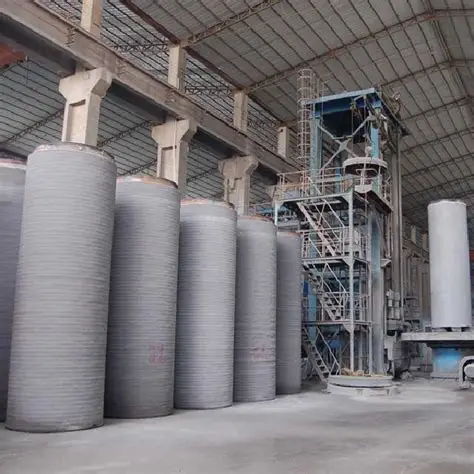
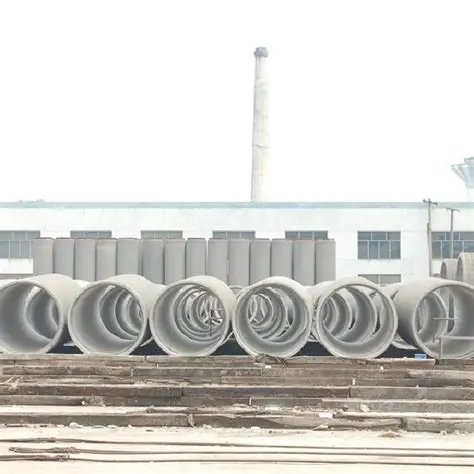
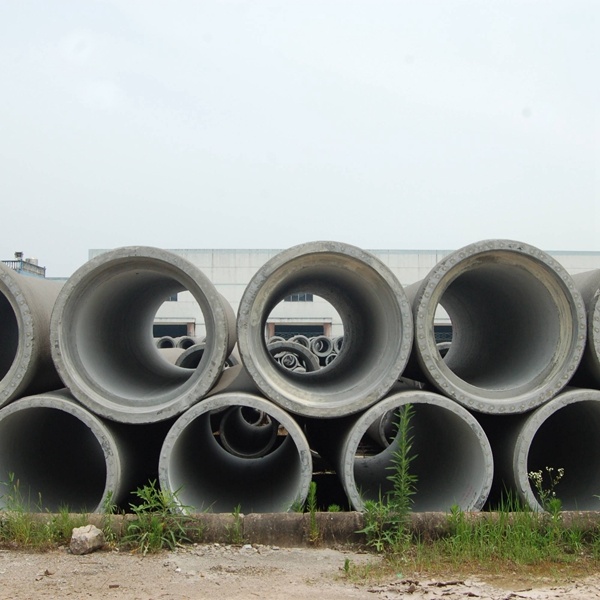
It is a specialized pipe for high-pressure water transport that achieves high strength and resistance to cracking by actively applying pre-stressed forces. It holds a particularly important position, especially in the field of large-diameter pressure pipelines.
1. Core Principles
Before or after the concrete pouring, the circumferential reinforcement is tensioned to put the pipe body into a pre-stressed state before it bears any load.
It effectively counteracts the tensile stresses generated during use, significantly enhancing its resistance to cracking.
2. Key advantages
High pressure resistance: Suitable for medium to high-pressure water transmission scenarios (working pressures typically range from 0.4 to 1.2 MPa).
High resistance to seepage: Pre-stressing inhibits the formation of cracks, and its sealing properties are superior to those of conventional concrete pipes.
Durability and economy: Designed to last for over 50 years, with a comprehensive cost-effective life cycle.
3. Typical Applications
Urban water supply main network.
Large-scale water diversion/transmission projects.
Power plant circulating water pipeline.
Pressure drainage and irrigation systems.
4. Common Types
Pre-stressed concrete pipes (CTP): No steel casing; cost-effective and practical.
Prestressed Steel Cylinder Concrete Pipe (PCCP): Features an internal steel cylinder, providing enhanced pressure resistance and waterproofing capabilities, making it suitable for more demanding engineering projects.
Performance
Excellent resistance to cracking and seepage.
The pre-stressing effectively counteracts the tensile stresses generated in the pipe wall under working loads, significantly delaying and inhibiting the occurrence and expansion of concrete cracks.
The tube’s structure is highly dense, and high-quality interface seals (such as rubber rings) are employed, resulting in exceptional overall resistance to leaks.
Robust ability to withstand pressure.
These are specifically designed to withstand high internal water pressure. The operating pressure range typically ranges from 0.4 MPa to 2.0 MPa or higher, meeting the stringent requirements for long-distance, large-diameter, high-pressure water transmission.
Excellent rigidity and resistance to external pressure.
The pipe body has high stiffness, which enables it to effectively resist loads from buried soil cover, ground vehicle live loads, and construction pushing forces. It is suitable for deep-buried and pipe-laying projects.
Excellent resistance to cracking and seepage.
The pre-stressing effectively counteracts the tensile stresses generated in the pipe wall under working loads, significantly delaying and inhibiting the occurrence and expansion of concrete cracks.
The tube’s structure is highly dense, and high-quality interface seals (such as rubber rings) are employed, resulting in exceptional overall resistance to leaks.
Robust ability to withstand pressure.
These are specifically designed to withstand high internal water pressure. The operating pressure range typically ranges from 0.4 MPa to 2.0 MPa or higher, meeting the stringent requirements for long-distance, large-diameter, high-pressure water transmission.
Excellent rigidity and resistance to external pressure.
The pipe body has high stiffness, which enables it to effectively resist loads from buried soil cover, ground vehicle live loads, and construction pushing forces. It is suitable for deep-buried and pipe-laying projects.
Application
Urban water supply main network.
Large-scale water diversion/transmission projects.
Power plant circulating water pipeline.
Pressure drainage and irrigation systems.
Specifications
Core Specification Parameters
| Parameter | Typical Range | Description |
|---|---|---|
| 1. Nominal Inner Diameter | DN600 – DN4000 mm (Common range, larger sizes customizable) |
Its technical and economic advantages are most prominent in large-diameter (DN≥600) high-pressure water transmission applications. |
| 2. Effective Length | 5 m, 6 m (Common standard lengths) | Longer single pipe sections reduce the number of joints, enhancing the overall integrity of the pipeline. |
| 3. Working Pressure Rating | 0.4 MPa – 2.0 MPa (Or higher, depending on design) |
A core design indicator. Must be determined based on the project’s internal water pressure, soil cover depth, and surface live load. Common classifications include 0.4, 0.6, 0.8, 1.0, 1.2 MPa, etc. |
| 4. Soil Cover Depth Rating | 3 m – 10 m (Or higher) | Indicates the pipe’s capacity to withstand external earth loads. Together with the pressure rating, it forms the basis for structural design. |
| 5. Joint Type | Bell-and-Spigot with Steel Collar + Rubber Gasket Seal (Most common) | Often features a “dual gasket” seal design, allowing minor deflection while ensuring excellent sealing and quick installation. |
| 6. Pipe Type Classification | PCCP (Prestressed Concrete Cylinder Pipe) CTP (Core Type Prestressed Concrete Pipe) |
PCCP: Contains an embedded steel cylinder, offering the highest pressure resistance and impermeability. Suitable for large-diameter, high-pressure trunk mains. CTP: No steel cylinder, more economical, used for applications with slightly lower pressure requirements. |