Choosing a high-quality geotextile supplier directly determines project quality, construction efficiency, and overall costs—low-quality products may lead to safety hazards such as engineering leakage and settlement, while a suitable supplier can provide dual guarantees of “material supply + technical support”.
This article focuses on the entire geotextile procurement process, integrating industry standards and practical experience to provide purchasers with a one-stop guide covering “selection criteria + recommended high-quality manufacturers + frequently asked questions”. It helps quickly identify reliable suppliers that meet requirements and reduce decision-making costs.

Selection Criteria for Geotextile Fabric Suppliers
1. Qualifications and Compliance
Qualifications are the core guarantee of a supplier’s compliant operation and product quality. Especially for high-standard projects such as municipal and transportation projects, the following two types of qualifications should be focused on:
- Core Certification Qualifications: For international projects, attention should be paid to certifications such as DOT (U.S. Department of Transportation) and ASTM (American Society for Testing and Materials). Among them, DOT certification clearly requires that geotextiles must be included in the New York DOT Approved Products List (NY APL) to be used in relevant transportation projects; products not listed need to submit samples for testing and approval in advance. For domestic projects, focus on verifying ISO9001 Quality Management System Certification and Green Environmental Protection Building Materials Certification. For major projects, it is also necessary to confirm that the supplier has special professional construction qualifications.
- Basic Enterprise Qualifications: Verify whether the business scope on the business license includes geotextile production and sales, and whether the production license is valid. For environmental protection projects, additional environmental impact assessment (EIA) reports should be requested to ensure that the production process complies with environmental standards. Suppliers with qualifications such as high-tech enterprises and provincial-level “Specialized, Refined, Characteristic, and Innovative” enterprises can be prioritized for the shortlist, as their technical strength and innovation capabilities are more guaranteed.

2. Product Capability
There are various types of geotextile products, which need to be accurately matched according to project scenarios. A supplier’s product system and customization capabilities are key evaluation points:
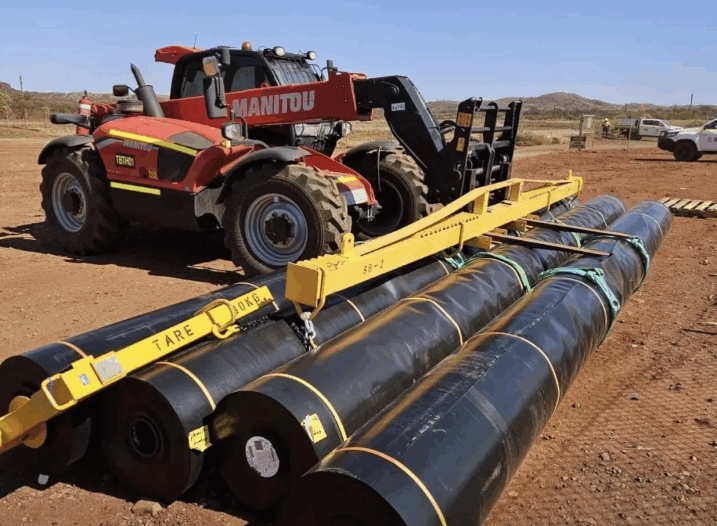
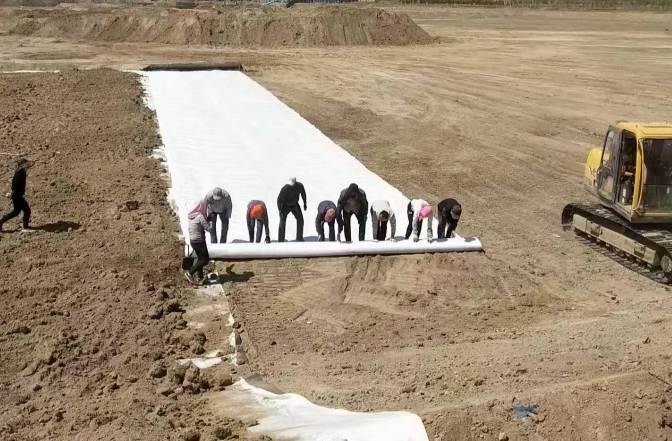
- Product Type Adaptability: Woven geotextiles have high tensile strength and are suitable for scenarios such as road reinforcement and slope protection; non-woven geotextiles have good permeability and are more suitable for drainage and filtration, and anti-seepage cushions in landfills. Before procurement, confirm whether the supplier can provide corresponding types of products, and whether the product parameters such as grammage (100-1000gsm) and material (polypropylene, polyester) can meet the project requirements.
- Customization and Quality Control Capabilities: Large-scale or special projects often require customized specifications and performance parameters, so it is necessary to confirm that the supplier has customized production capabilities. At the same time, verify its quality control system, and request full-process test reports from raw material procurement to finished product delivery, focusing on the test results of core indicators such as tensile strength, permeability, and corrosion resistance.
3. Delivery and Production Capacity
Insufficient production capacity or delayed delivery may easily lead to project shutdowns, so evaluation should be conducted from two aspects: production capacity scale and delivery efficiency.
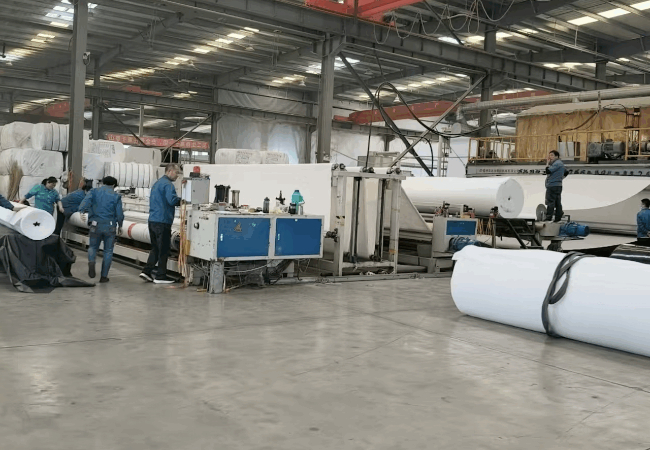
- Production Capacity Verification: Judge production capacity by inspecting the area of the production base, the number of production lines, and the scale of employees. For example, Shandong Lianjie Engineering Materials Co., Ltd. has 108 employees, including 21 professional and technical personnel. The company has two domestically leading geotextile production lines, as well as two production lines each for bentonite waterproof blankets, three-dimensional vegetation nets, geocells, three-dimensional composite drainage nets, and woven geotextiles.
- Delivery Efficiency Guarantee: Priority should be given to suppliers with warehouses or production bases in the project area.
Recommended Global High-Quality Geotextile Suppliers
High-Quality Geotextile Suppliers in China
Shandong Lianjie Engineering Materials Co., Ltd. is located in Tai’an High-Tech Industrial Development Zone. Founded in 2010, it currently has 108 employees, including 21 professional and technical personnel. The company has two domestically leading geotextile production lines, as well as two production lines each for bentonite waterproof blankets, three-dimensional vegetation nets, geocells, three-dimensional composite drainage nets, and woven geotextiles. Its products are mainly used in infrastructure projects such as highways, railways, airports, ports, coal mines, water conservancy, power engineering, soil and water conservation, and environmental greening. They have been widely applied in many national key projects including expressways and railways, winning high praise from engineering experts and customers.
High-Quality Geotextile Suppliers in International Regions
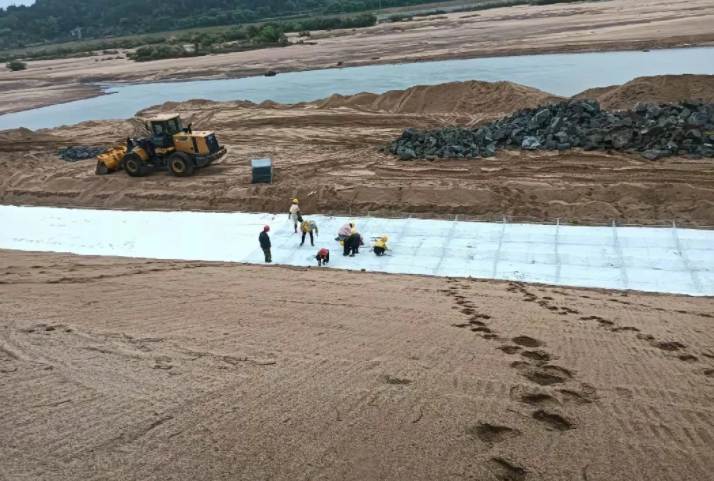
- W.P. Law Inc. (South Carolina, USA): Preferred choice for North American municipal projects. Its core products are geotextiles for drainage, serving municipal water systems, pond drainage and other projects for a long time. It has established cooperation with multiple brands, and its products comply with DOT and ASTM standards, adapting to the needs of local transportation and municipal projects in the United States.
- Koninklijke TenCate (Netherlands): Benchmark in the global high-end market. As a core player in the global geotextile market, it focuses on the R&D of high-performance geosynthetic materials. Its product line covers the entire range of woven and non-woven products, adapting to diverse scenarios such as roads, environmental protection, and marine engineering. With strong technical strength, it is suitable for overseas high-standard projects.
- Techfab India Industries Ltd. (India): Cost-effective choice in the South Asian market. Focusing on the production of geotextiles and supporting products, its products adapt to the needs of infrastructure projects in India and surrounding countries. With prominent price competitiveness, it is suitable for overseas small and medium-sized projects with limited budgets.
Frequently Asked Questions About Geotextile Procurement
1. How to choose between woven and non-woven geotextiles according to the project?
The key lies in the core needs of the project: If the main requirement is to solve soil reinforcement and anti-stretching problems (such as road base reinforcement, slope protection, and retaining wall backfilling), woven geotextiles are preferred for their high tensile strength and stable structure. If the core demand is filtration and drainage, or anti-seepage and isolation (such as filter layers for underground drainage pipe networks, leachate isolation layers in landfills, and filtration for farmland water conservancy irrigation), non-woven geotextiles are selected for their loose fibers, good permeability, and high filtration precision. For complex scenarios, consult suppliers for customized composite geotextile solutions.
2. What technical parameters need to be clarified in advance when purchasing geotextiles?
Four core parameters should be clarified according to the project design requirements: ① Product type (woven/non-woven); ② Grammage (weight per unit area, 100-1000gsm; generally, higher grammage indicates stronger tensile strength); ③ Material (polypropylene has high cost performance and good chemical corrosion resistance; polyester has better high temperature resistance and tensile performance); ④ Core performance indicators (tensile strength, elongation at break, permeability, equivalent aperture, etc.). If the project has special requirements, environmental standards (such as degradability requirements) and dimensional specifications (width, length) should also be clarified.
Conclusion
The core logic of geotextile procurement is “demand matching + risk control”: First, clarify the core requirements of the project such as region, scenario, and technical parameters, then screen suppliers through four dimensions—”qualifications, products, delivery, and reputation”. Priority should be given to manufacturers that match the project scale and scenario: For large-scale and major projects, lock in leading suppliers with strong qualifications and rich experience; for regional small and medium-sized projects, choose local suppliers with high cost performance and flexible response; for overseas projects, prioritize international suppliers that comply with local standards.
For customized geotextile procurement solutions, feel free to contact us!
Reference Sources
- Reference: DOT (U.S. Department of Transportation Standards), NY APL (New York DOT Approved Products List)
Source Name: 《Department of Transportation (DOT) Geotextile Specifications》 - Reference: ASTM (Material Standards) – Test specifications for geotextile tensile strength, permeability, etc.
Source Name: 《ASTM D4354-16 Standard Specification for Geotextiles》 - Reference: ISO9001 Quality System Certification, Green & Eco-friendly Building Material Certification
Source Name: ISO9001:2015 International Standard / GB/T 35601-2017 《Green Building Materials Assessment Standard》